A story written with a brush : each miniature work , the narrator of an iranian story
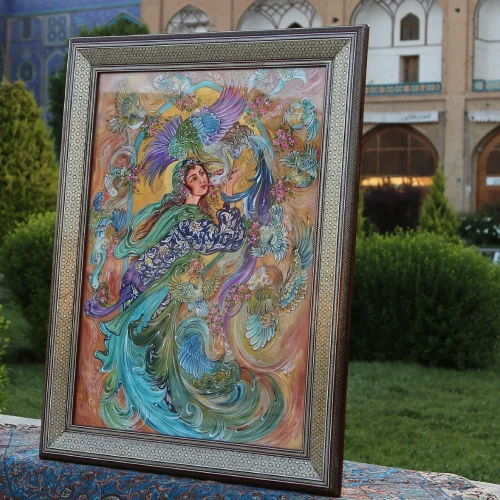
Story of Miniature
Among different kinds of Iranian Arts, miniature painting has its own exclusive position which today in many far parts of the world know Iranian community first by Iranian rugs, second by miniature paintings. Miniature painting goes to centuries ago, which ant that time painters started to impress Iranian culture in form of Iranian miniature painting using precious and expensive rare materials as dyes and pastes made from gold, silver, copper, ferrous pigments, turquoise powders, lapis lazuli, and other precious pigments to express Iran and Iranian painting to the summits of eastern arts. After Islam this art got more religious form and in most religious books like the Quran, religious poems and textbooks you can find master pieces and breath keeping miniature paintings which today you can find just in museums around the world. In this article you will learn more about Iranian miniature art.
The roots of modern and well known antique Persian miniature painting return to 13 centuries after Mughals invasion to Iran. But the best time for flourishing persian miniature art which brought this art to the summit of its position is 15 and 16 centuries. Because of the domination of Mughals, the faces in the paintings are Three - quarters to full round faces like Mughals and most of the painting and motives are informed of hunting sceneries, animals, birds, flowers …etc. in this era you can find famous Persian miniature paintings in best forms. One of the best books about this article Is “Shanae Abu mansoori “and “shah name bai songhori” which are now kept in famous museums of the world.persian miniature artists made masterpieces of persian miniature arts and made different schools of arts which in all of them you can find common general features like bright colors, the even light and lack of shadow, three-quarter and round faces, simultaneous spaces and time. In most of the miniature paintings there is a lack of technique named as perspective. Nobody knows why the Persian artists suffer the lack of this pivotal technique but in 19 and 20 centuries by learning from European schools the painters learned how to manage this procedure and after that you can find this differentiation in the persian miniature prints, in books and on the walls of new palaces that improved the islamic miniature painting and book illustration in a proper manner. All the pigments and colors used in miniature paintings were natural and even paper for painting was handmade and made from natural ingredients like cotton or other natural ingredients. As I said before most of these materials are very expensive and they used pure gold or silver or other expensive materials to decorate paintings.
You can find Authentic Iranian paintings and miniatures in the works of the today master of Iranian miniature painting books of master “Farshchian” the miniature painter . farshchian miniature has a prominent role in persian miniature art history and he is known as one of the most famous persian painter . “Farshchian” raised the role of a painter to the high picks of persian miniature art history which today not just inside the country but he is known to the high ranking museums of western world and his works are shown in galleries and workshops of different cultural centers in the world. He is a real master and he taught many students around the famous art universities inside and outside the world. I should search about Farshchian miniatures and observe his work .
Where to find original Iranian paintings in miniature
If you visit Isfahan , you can find many shops and galleries where the painters are working against you and you will see how simple their tools are and how silent they are when concentrated to paint a very small face on a very small piece of paper. In some cases they use camel bones as paper. They used a plain sheet of camel bone and started to paint on it, normally this is basically as an ornamental piece of art just good for decoration but they make jewelry box, mirrors, photo frames and other things to use for decoration or as a functional object. In old times they used ivory instead of camel bone, today using ivory is illegal because of protecting the elephants against poaching and most of the painters use camel bones to repeat the ancestor’s heritage as miniature painting on Ivory. persian miniature painting on ivory was so attractive that around the “homayoon” kingdom in Mughals era two famous miniature painters in the name of “ Mir sayyid Ali and Abd us-samad “ trained in the court of Persia for miniature paintings and after that they established the first atelier of painting in India. In this form the art of Iranian painting on Ivory and paper was exported to other countries like India and even in other continents like Africa and Europe in the 15th and 16th centuries. To make a bone sheet of camel bone there are other craftsmen that in a very hard and time consuming procedure they extract the Greece and oil from the thick parts of camel bones and after cleaning and polishing the bone, they supply the big market of miniature painting in Isfahan and other cities who are working in this demanding market.
In antique and modern Iranian miniature painting there are simple tools which are very similar to normal paintings. The only difference is all the tools, especially the brushes which are used to make very delicate lines in miniature painting are very small and delicate too. Sometimes the strands of hair of animals like male cats are used as the brush hair. Sometimes the number of strands are few to one or two strands for lining the eyelashes of the face of a woman or sometimes more. The size is different but at last very delicate and small in case of need. miniature painting supplies are different two. For example, the paint for miniature painting is normally water based in old times and now. But the quality is different. Most of them are made from natural pigments and ores and even blood of different animals. In normal situations the painter followed persian miniature painting techniques and used natural ingredients like plant resins and other additives and mixed them in a very complicated process, they used water based solvents until they found maturity and after that they used it as a normal paint in Persian miniature prints and painting. Today something changed. There are a vast variety of paint for painting in market, some other water soluble paints and water colors are used for painting, acrylic paints are available in a vast number and quality which is attractive for the Persian miniature painters, and many painters prefer to use them instead of old fashion paints their ancestors used decades ago. But some of the masters who are more conservative insist on using natural colors and following the Persian miniature painting techniques and never accept to use artificial ingredients. Just time shows the result and reveals what is correct and who is wrong, who says the right and who says the wrong.it takes a long time to learn how to paint miniature painting for a student and even after that a new painting is a new challenge for a master. It is a very hard and time consuming job for the painter to learn how to paint details and weeks and months need to paint a miniature to complete. There are thousands of iranian miniature paintings for sale in recent years, but finding a genuine good quality painting is hard. hard enough to say there are paintings that today are sold for thousands of dollars. Even if it is an expensive job, you can find very small and valuable paintings in the market for a few dollars. Cheap but beautiful. You can find a very small jewelry box at a very reasonable price to present it to your dear wife or your daughter or you can buy a very attractive pen case made from leather or camel bone decorated by a hunting scenery painting and make your friend happy. It is beautiful, functional and tells the history of a thousand years from a historical territory named Persia or Iran.
One of the natural ingredients used in colors and paintings for miniature painting supplies in the present and past is pure gold in the form of a paint. Unfortunately, today this paint is imported from western countries in famous brands but in the past the painters made their own golden colors. First of all, they had to make a very fine powder of gold to add it to the other ingredients like pure herbal resins and solvents. But gold is a metal and grinding is not possible and cutting it in a very thin and fine material is impossible. So how did they do this job? It was a very long process. First of all, after melting the gold, they pour it in the air and splash it in a way very thin layers of metal made like very delicate chips. After that they put those chips between thick layers of wet ox leather. Layer by layer they made a thick cake of leather and gold chips. After that they stitched all layers together and pulled it in a bucket of water for days. Each day they brought the leather and metal cake out and hammered it by a very heavy sledge and hammer. Weeks of hammering the cake got thinner and thinner. The master knew how to control the process and at last at the time of truth he brought out the cake and opened it. Between the layers they could find very thin layers of gold that foiled in tenth of millimeters of thickness. Just by touching and rubbing the thin metal layer the gold changes to small particles and powder. After drying the powder is ready to use as a pigment or ingredient to make a very fine and shiny gold paint. Next time you are visiting the internal walls and ceiling of “ chehel sotoon palace”. look at the fine golden paints of the ceiling that lasts for 400 years. Sana Persian wishes to visit you in Isfahan in the near future to show you the Persian miniature paintings of Isfahan.
Contact Us
+989054577261



Connect with Us for Your Iranian Adventure
We would love to hear from you. Whether you're planning a trip to Iran or looking to collaborate with us, feel free to reach out. Let's connect and make your Iranian journey memorable!
Don’t like the forms? Drop us a line via email.
support@sanapersian.travel
© Rahweb 2024. All rights reserved
Contact Us
Contact Us
+989054577261© Rahweb 2024. All rights reserved