Chubtashi – An Authentic Art of Mazandaran
Story of Lacquer Carving
Wood carving, known locally as Lak Tarashi or Chutashi, is an ancient traditional art of Mazandaran, practiced on wood.
By examining the handicrafts of different regions of Iran, one can see that local crafts have always been deeply intertwined with nature, culture, and the surrounding environment. Throughout history, humans have sought to meet their needs in harmony with nature, using available resources to create both functional and aesthetically pleasing tools. Humans have always used natural materials like soil, stone, wood, metal, plants, animals, water, and other resources to create objects that are practical and culturally significant. Wood carving follows this principle and, like other indigenous arts, has developed over time. These crafted objects, often essential to daily life, are also cultural treasures that carry nostalgic and symbolic significance.
Wood carving is an ancient Iranian craft, especially prevalent in Gilan, Mazandaran, and Golestan provinces. In Mazandaran, it is most commonly known as Chutashi—“Cho” meaning wood and “Tashi” meaning carving. In this art, the craftsman uses various tools—many handmade locally—to carve wood and create functional items needed in daily life. Wood carving is closely connected to daily living, which explains why many people in the past practiced it extensively. In northern provinces like Mazandaran, where forests are dense and the climate humid, wood has been a primary raw material for producing various handicrafts. The availability of quality wood in these regions has fostered the growth of arts like wood carving, wickerwork, inlaying, and knotting, forming a significant part of local culture and identity.
In Gilan and Mazandaran, the diverse climate and proximity to the sea and forests allow access to many types of trees that are dense, flexible, and easy to carve. Trees commonly used in wood carving include beech, elm, maple, boxwood, mazu, angelica, oak, and others.
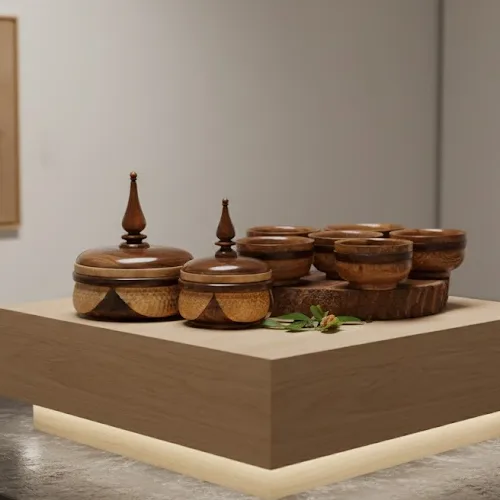
The history of wood carving in Gilan and Mazandaran dates back 8,000 years. Given the richness of Mazandaran’s forests, it is not surprising that wood carving has flourished here. Woodwork has always held a special place in Mazandaran’s history. Locals have long used wood carving to make a variety of functional and decorative items, such as bowls, spoons, ladles, lacquers, jules, and containers, meeting their daily needs while creating artful objects.
Wood carving requires specific materials and tools, many of which have been in use for centuries and have local names:
• Wood: The only raw material in this craft. Different types of trees are selected based on the intended product, strength requirements, and characteristics. Common woods include boxwood, maple, beech, angelica, and others. Products made from tree roots are lightweight, durable, and resistant to temperature changes, lasting 100–300 years with proper care.
• Axe (Tor): Used for cutting trees and branches; some stages of carving also employ the axe.
• Sickle (Das): A wooden- handled tool with a curved steel blade, used to cut smaller branches.
• Chisel (Tashe/Tisha): For carving and shaping wood, reducing diameter, or hollowing containers. Chisels come in straight and curved forms.
• Delle-gir: A U-shaped blade used to hollow round containers like bowls.
• Wide Chisel (Jule Tashe): For hollowing and shaping deeper containers.
• Plane (Randa): Used to reduce thickness of elongated objects like sticks.
• Dar-kon or Matkol: Similar to modern flat chisels, used to hollow or deepen wooden vessels. A wooden mallet (Kama) is used to strike the dar-kon, followed by smoothing with a Rokh.
• Rokh: A chisel with a long handle and narrow steel blade for smoothing and shaping carved objects.
• Pattern Carver (Naqsh-andaz): A U-shaped chisel for engraving designs on wooden surfaces.
• Kama: Wooden mallet for striking chisels like dar-kon.
• Sharpening Stone (Sos-sang): A siliceous stone used to sharpen tools.
• Knife: For carving and engraving patterns.
• Scraper (Liseh): Removes irregularities during final stages.
• Sandpaper: For smoothing the finished product.
• Select the appropriate wood for the desired product.
• Adjust the wood’s moisture.
• Carve the item using chisels and other tools.
• Finish by smoothing and adding decorative
• patterns.
Common wood-carved items include jule, julche, lacquered containers (Lak, Lakche), Ket Lak, paste grinders, garlic crushers, sugar containers, tobacco containers, and many other daily-use objects. These wooden products have traditionally been sold as souvenirs from Gilan and Mazandaran and exported to other provinces and countries. We hope to welcome you soon in Mazandaran, Iran, to our workshops and stores for wood carving, providing a memorable experience for you and your family. We look forward to that day in the very near future.
Contact Us
+989054577261










Connect with Us for Your Iranian Adventure
We would love to hear from you. Whether you're planning a trip to Iran or looking to collaborate with us, feel free to reach out. Let's connect and make your Iranian journey memorable!
Don’t like the forms? Drop us a line via email.
support@sanapersian.travel
© Rahweb 2024. All rights reserved
Contact Us
Contact Us
+989054577261© Rahweb 2024. All rights reserved