
Zilo
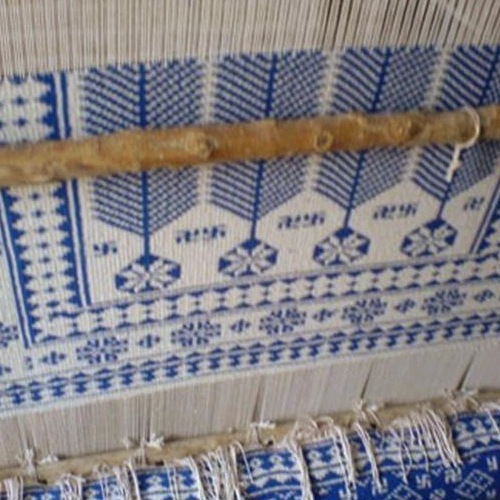
Story of Zilou Weaving
Zilou is a type of handwoven mat and floor covering made exclusively from cotton thread, unlike carpets and rugs which often use wool or hair. Its cotton material makes it cool and comfortable, making it especially suitable for arid regions. Zilou closely resembles a kilim, with the main difference being that kilims are woven from wool. This type of mat is traditionally used in several regions of Iran, particularly in desert areas such as Yazd, Meybod, Ardakan, and Naein. In the past, because of its lightness, affordability, simplicity, and ease of cleaning, zilou was also widely used as a floor covering in mosques in desert regions. Zilou is an ancient and historical craft; even the famous traveler and poet Nasir Khusraw mentioned 500 weaving workshops in his travelogue. The province of Yazd, particularly the city of Meybod, has long been renowned for producing these mats. Today, the younger generation continues to show interest in zilou, and some workshops in Meybod, Yazd, and Ardakan still produce it.
Zilou weaving shares many similarities with mat weaving. Its origins in Iran date back to before the advent of Islam and it is considered one of the country’s most important traditional handicrafts. Historical texts rarely mention zilou by name, and references often appear only in the context of mosques or religious spaces where it was used as a floor covering. There is no doubt that the history of zilou predates Islam, and even in the early centuries of Islam, it had reached an advanced level of artistic design and weaving in Iran. Its use in religious places such as mosques and husseiniyas (Shia congregation halls) has deeply connected zilou to spiritual and community life. Even today, it remains a traditional floor covering in historical mosques and shrines.
Meybod was historically one of the main centers of zilou weaving. Until recently, hundreds of families in Meybod earned their living from it, and some still do. Ardakan also had—and still has—numerous zilou workshops, with a few master weavers like Mohammad and Ali Shojaoddini continuing the tradition. Although zilou may appear as a simple cotton mat, the weaving techniques involved are highly sophisticated. Some researchers even do not distinguish between zilou and kilim, but in reality, they differ both in raw materials and weaving methods. Zilou uses intricate weaving techniques rarely found in other textiles, even kilims.
Zilou is more compatible with agricultural and rural lifestyles because both its warp and weft are made from cotton, whereas kilim corresponds more closely to pastoral and nomadic life, being predominantly made of wool and suitable for colder climates. Zilou, with its cotton threads, is ideal for the dry and hot regions near deserts, making it a perfected evolution of kilim weaving. Historically, it was woven in all cotton-growing regions of Iran. For instance, the author of Hodud al-‘Alam mentions zilou production in Jahrom, Sistan, and some villages in Azarbaijan. Early historical texts refer to it only as a floor covering in mosques. According to Dehkhoda, zilou is a general term encompassing both rugs and mats, while Jamalzadeh clarifies that the difference between zilou, pilas, and kilim lies in materials and weaving style: kilims are thin woolen rugs resembling zilou, whereas zilou refers to a specific type of cotton rug. Nâzem al-Atba notes that the finest zilous are woven in Yazd.
Zilou, like the desert plains it comes from, appears simple on the surface but holds intricate secrets within. These mats bring comfort to people enduring the intense summer heat of desert nights, much like the coolness of desert sands. This might explain why villages and towns around the deserts, especially Meybod, have been renowned for its weaving for centuries. Historical records indicate that nearly every household produced their own basic textiles, including floor coverings such as pilas and zilou. In this context, zilou weaving thrived, and many mosques and shrines across Iran were furnished with Meybod-made zilous.
European travelers, like Sykes, often referred to red Meybod mats as “kilims,” although true kilim weaving was uncommon in Meybod. The term “kilim” likely became a popular misnomer due to the superficial resemblance of the two crafts. The patterns of zilou reflect the material, spiritual, and cultural life of Meybod’s inhabitants, revealing the local weavers’ creative input and unique designs.
The zilou loom is similar to a carpet loom and consists of several main parts:
• Tir (beam): Two horizontal wooden beams made from mulberry wood, placed three meters apart on two vertical posts. The upper beam holds the warp, while the lower one is used for rolling the woven mat.
• Pillars: Two vertical posts that support the beams, made from
• slightly curved mulberry trunks to ensure proper tension of the warp.
• Tang: Thick wooden rods with pointed ends, used to wrap the warp around the beams and secure it. Each loom has two tangs.
• Pashband: A long wooden or metal rod placed across the width of the loom to
• hold the “kamune” or clamp.
• Shamsh (Gart): Horizontal rods used in weaving the patterns. There are typically two per loom: upper and lower.
• Kamune: A wooden strip with grooves, tied to the shamsh and helps control pattern weaving.
• Koli: Fork-shaped wooden piece attached with thick cords to the upper beam and pashband to stabilize the loom.
• Shelit: A collection of twisted threads arranged horizontally across the loom, forming the structure for weaving the mat. Shelit threads are divided into smaller
• groups called “Moj” (rows), each with a specific role in the design. The number of Moj depends on the pattern complexity, ranging from 7 for simple home mats to 13 for decorative mats used in mosques.
Types of Zilou by Use and Color
• Blue and white: For
• mosques and religious spaces.
• Blue and clay: Economical type for home use.
• Green and clay (Naftal type): The most premium type.
Following approval from continental representatives and a final vote by the World Handicrafts Council in the UK, Meybod’s zilou was officially registered as a global cultural heritage.
Zilou, kilims, rugs, and carpets all have long histories and practical uses, making them among the most cherished Iranian handicrafts and souvenirs. When visiting Iran and Yazd, consider taking a piece of zilou as a memorable keepsake from this historic land. As a small part of the Sana Persian team, we look forward to welcoming you to Iran .
Contact Us
+989054577261










Connect with Us for Your Iranian Adventure
We would love to hear from you. Whether you're planning a trip to Iran or looking to collaborate with us, feel free to reach out. Let's connect and make your Iranian journey memorable!
Don’t like the forms? Drop us a line via email.
support@sanapersian.travel
© Rahweb 2024. All rights reserved
Contact Us
Contact Us
+989054577261© Rahweb 2024. All rights reserved