Charugh Making
Story of Charogh Making
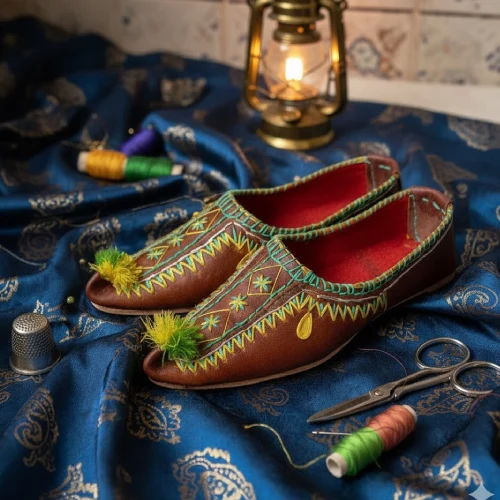
Charogh refers to a traditional type of footwear that has been used since ancient times in different styles and forms. In earlier days, it was mostly made of leather. According to the Moein Dictionary, charogh—also known in Turkish as charq or palik—is a leather shoe fastened with straps that wrap around the foot and reach up to the ankle. Charogh is one of the renowned handicrafts of North Khorasan, especially in the cities of Bojnourd and Quchan, as well as in Zanjan.
In local Turkish dialects, it is pronounced charkh. The charogh mentioned in our classical literature (for example in the phrase “Let me sew your charogh, as I comb your hair”) resembles the styles still made in North Khorasan, which have preserved much of their originality.
Charogh is both a decorative and practical craft. It has a delicate structure and was originally designed for walking indoors on carpets and rugs. In the past, it was closed at the back and had no heel. In recent years, however, heeled versions resembling slippers have appeared. The soles remain leather, while the uppers are decorated with silk threads and gilt embroidery in a variety of colors.
Charogh-making is an old tradition. Farmers once made them themselves from rawhide, but later, treated leather became common. The modern form, however, has been around for less than a century. One of the earliest apprentices of Master Khatibi was Mr. Azad Ali Mohammadi, who mastered the craft and eventually opened his own workshop, carrying on the tradition. Today, he is recognized as a distinguished master of this art. Other apprentices, after Khatibi’s workshop closed, continued practicing the craft with support from the Cultural Heritage and Tourism Organization, ensuring that charogh-making survived. At present, charogh is considered one of Zanjan’s most valuable and beautiful handicrafts. It is sold as a popular souvenir and exported to other cities and countries.
As with any shoe, production begins with a mold, which in the past was sometimes carved from wood or shaped from clay. The prepared leather is moistened, stretched over the mold, and fixed with thread or fabric. The mold is then removed, and the upper part is stitched to the sole using silk or cotton thread. Today, charoghs are no longer worn in everyday life but are made mainly as decorative footwear. They are often crafted as indoor slippers, richly adorned with silk, metallic thread, and other embellishments. The sole may be made from durable thick leather, or from several layers of cotton fabric stitched together. In modern versions, synthetic soles, PU, or even rubber are sometimes used. Once considered one of the finest traditional shoes of Iran, charogh continues to be produced and is now exported abroad as a cultural souvenir. We hope that if you ever travel to Khorasan, you will bring a pair of charoghs as a gift for your loved ones. We look forward to welcoming you to Iran, in the beautiful province of Khorasan—perhaps one day as your hosts at Sana Persian Team.
Contact Us
+989054577261










Connect with Us for Your Iranian Adventure
We would love to hear from you. Whether you're planning a trip to Iran or looking to collaborate with us, feel free to reach out. Let's connect and make your Iranian journey memorable!
Don’t like the forms? Drop us a line via email.
support@sanapersian.travel
© Rahweb 2024. All rights reserved
Contact Us
Contact Us
+989054577261© Rahweb 2024. All rights reserved