pole Veresk
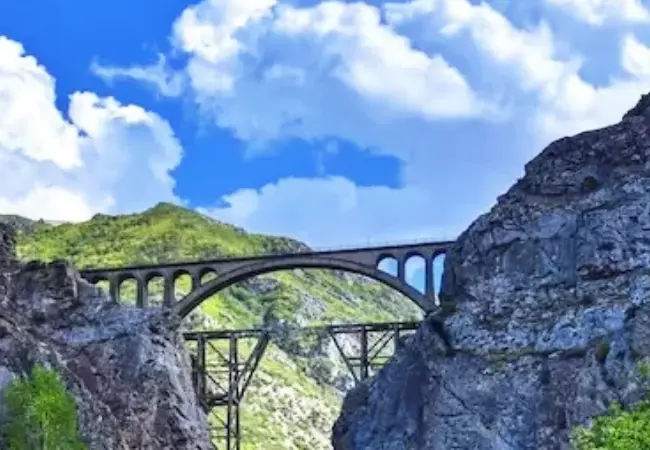
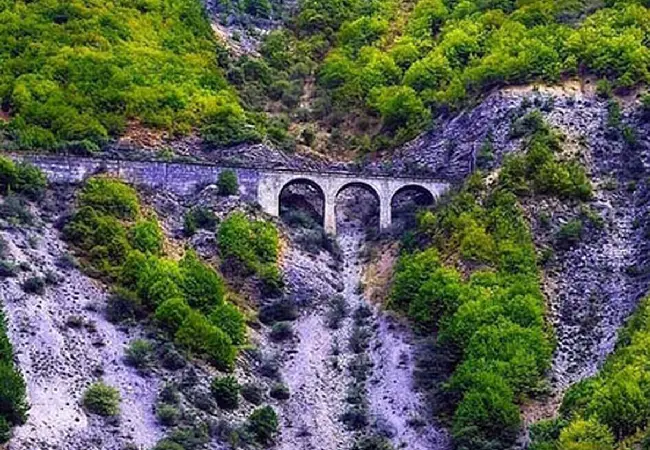
Veresk Bridge
Veresk Bridge is recognized as one of the largest railway bridges in Iran. It is located in the village of Veresk, 27 kilometers south of Pol-e Sefid in Savadkuh County, Mazandaran Province. This bridge is considered a masterpiece of engineering in the railway industry, both in Iran and globally. It was constructed during the reign of Reza Shah in 1936 (1315 in the Iranian calendar) and has been operational since then. Veresk Bridge connects the Tehran–North national railway line and stands 110 meters above the valley, with a main span of 66 meters, built using the simplest tools of its time, yet technically unique. Veresk Bridge is one of the most important engineering landmarks in northern Iran and was registered as a national heritage site in October 1977 (registration number 1534). The bridge is considered strategic and was designed and constructed by the Danish company Kampsax with a 70-year guarantee. During World War II, British Prime Minister Churchill nicknamed it the “Victory Bridge,” and on July 14, 1945, the Ministry of Roads officially named it the Victory Bridge.
This historic bridge was built exclusively for trains. Today, Tehran–Sari and Tehran–Gorgan passenger and freight trains still cross it daily after 85 years of service. Veresk Bridge is also listed in the Guinness Book of Records for its height, exceeding 61 meters.
According to reports from Etelaat newspaper dated April 25, 1936, and the Kampsax archives, the bridge was designed by Austrian engineer Ladislaus von Rabcewicz, known as the Veresk engineer. He mentioned in an interview: "When I prepared the model for the construction of Veresk Bridge, other engineers looked at it with astonishment and considered its implementation a major triumph in engineering science. Today, everyone praises the bridge and considers it one of the most beautiful engineering masterpieces."
Rabcewicz was also responsible for constructing the railway tunnels and was a pioneer of the Austrian NATM tunneling method.
The name “Veresk” comes from the nearby village, which originally had about 20 families. The area behind the bridge was abundant with Veresk shrubs, which is another origin of the name. Another source suggests it is derived from the name of a Bohemian engineer, Szeszowski, who worked on the project.
Veresk Bridge was constructed with very basic tools such as small dynamites and manual drills. The bridge is made from washed sand, cement mortar, and bricks, without using reinforced steel, which makes it unique. Its construction involved first building two concrete bases on either side of the mountains, connecting them, then placing the arch slab, and finally adding a brick facade. Due to the risk of flooding in the Veresk River, engineers built a tunnel beneath the river to protect the bridge and trains. After passing through the tunnel, the tracks ascend 100 meters before crossing the bridge. The total volume of the bridge is approximately 4,500 cubic meters, with an overall length of 86 meters and construction costs of 2,600,000 rials at the time. Several plans were proposed, and the most economical was approved.
During WWII, with the threat of Allied use of Iran’s railways, all bridges were to be mined, including Veresk Bridge. Fortunately, none of the mines detonated, and they were later safely removed. During the war, an average of one train every 25 minutes carried military equipment across the bridge to supply the Soviet front. The bridge was painted white under orders from local authorities at that time.
In 2016, 80 years after its construction, Sharif University of Technology assessed the bridge’s structural health. Sensors were installed to monitor vibrations, and worn-out parts were regularly replaced. The inspections confirmed that the bridge remains structurally sound and continues to serve both freight and passenger trains safely.
Veresk Bridge is located in the Veresk Valley, Savadkuh County, 85 kilometers from Qaem Shahr and 180 kilometers from Tehran, along the Firuzkooh railway line. It connects two massive and rugged mountains, Abbasabad. The surrounding area offers breathtaking natural scenery, including the Gordeh Gaduk pass, Shurab Waterfall, and three parallel railway tracks known as the “Golden Lines” of Veresk. Tourist trains now operate daily from Tehran to northern Iran, allowing travelers to enjoy the beauty of the area and create unforgettable memories. We hope that in the near future, the Sana Persian team will have the pleasure of hosting you to visit Iran, Mazandaran Province, Veresk Bridge, and its surrounding beauty. Looking forward to that day very soon.
Contact Us
+989054577261




Connect with Us for Your Iranian Adventure
We would love to hear from you. Whether you're planning a trip to Iran or looking to collaborate with us, feel free to reach out. Let's connect and make your Iranian journey memorable!
Don’t like the forms? Drop us a line via email.
support@sanapersian.travel
© Rahweb 2024. All rights reserved
Contact Us
Contact Us
+989054577261© Rahweb 2024. All rights reserved