
Masjede Jamkaran
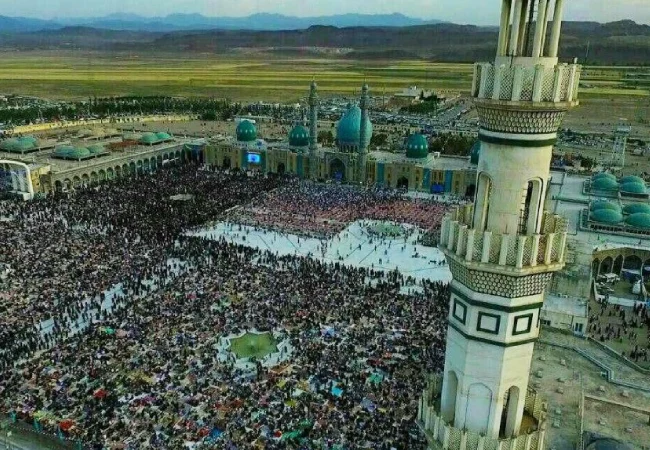

Jamkaran Mosque
Jamkaran Mosque, also known as the Mosque of Sahib al-Zaman, and formerly called Qadamgah or Hasan ibn Musalla Mosque, is one of the most famous and significant mosques for Shia Muslims. It is associated with Imam al-Mahdi (Hujjat ibn al-Hasan), the twelfth Shia Imam, and is located in the Jamkaran neighborhood of the city of Qom. Its name comes from the neighborhood in which it stands, while its association with Imam al-Mahdi gives it the title Mosque of Sahib al-Zaman. Historically, it was also known as Qadamgah Mosque. According to the Encyclopaedia of Islam, Jamkaran was an important village in the past, frequently mentioned in historical records of Qom. The mosque has a history of over 1,000 years, and in recent centuries, due to the attention of Shia scholars, it has become one of Iran’s major pilgrimage sites, around which particular customs and beliefs have developed. The mosque complex includes administrative offices, a board of trustees, a security department, an office for recording miraculous events, Jamkaran Book Publications, research and guidance units, a specialized library, a clinic, a kitchen, guest accommodations, and more.
According to the history of Qom, the first mosque built in the city before the migration of the Ash‘aris from Koubeh to Qom in the early 2nd century AH was the village mosque of Jamkaran, founded by Hatab Asadi, who used to pray there alone. Tabatabai suggested that the current Jamkaran Mosque may be the same mosque established by Hatab Asadi, which later expanded when members of the Hatibah branch of Banu Asad settled in Jamkaran during Mukhtar’s uprising in Kufa.
However, the more widely accepted account, narrated by Mirza Hossein Nouri, attributes the construction of the current mosque to a vision experienced by Hasan ibn Mosalla Jamkarani. According to this story, on Tuesday, the 17th of Ramadan, 373 AH, he met Imam al-Mahdi, who instructed him to build a mosque at the location he had been shown. He was also instructed to perform a specific prayer in the mosque and to sacrifice a goat, distributing it among the people. Later, Sayyid Abul Hasan funded the mosque using the proceeds of the land and additional donations, constructing it with a wooden roof. In recent decades, many Shia scholars and maraji’ (religious authorities) have shown special reverence for this mosque, performing prayers there and recommending it to others. Najm al-Din Tabasi, quoting Naser Makarem Shirazi, affirms that Jamkaran Mosque has a definite historical record and was established by Imam al-Mahdi, and any doubts about its authenticity should not be entertained.
During the late Qajar and early Pahlavi periods, the old mosque building had partially collapsed. The modern popularity of the mosque is largely credited to Mohammad Taqi Bafghi, who revived the tradition of visiting the mosque on Wednesday nights, performing prayers from Maghrib until dawn, and gradually attracting more visitors. After the first board of trustees was established in 1394 SH (1975–76 CE) under the supervision of the Endowment Organization, more attention was given to the mosque. Following the Islamic Revolution, the management council of Qom Seminary appointed members of the board of trustees, while the Endowment Organization oversaw the mosque’s affairs. Today, Jamkaran Mosque continues to welcome around 15 million visitors annually.
Many Shia pilgrims visit the mosque on Wednesday nights and on the night of mid-Sha‘ban, the birthday of Imam al-Mahdi, performing two special prayers: the two-unit Salam prayer upon entering the mosque and the two-unit “Imam Mahdi prayer,” performed in a specific manner.
According to the Encyclopaedia of Islam, construction of the mosque began before the Afsharid era. However, little is known about Safavid architectural elements in the mosque. According to inscriptions, in 1167 AH, Mirza Ali Akbar Jamkarani repaired the mosque, which then included a columned mosque measuring 5 × 17 meters, four prayer halls, and a southern courtyard of 17 × 13 meters. Later repairs were carried out by Mirza Ali Asghar Atabak during the early reign of Muzaffar al-Din Shah, including chambers, iwans around the courtyard, and two water reservoirs. Bafghi also made improvements, adding another water reservoir. During Qajar-era renovations, the mosque was decorated with tilework, seven-color mosaics, gold-painted arabesque designs, and inscriptions in Thuluth script from Surah Al-Jumu‘ah.
A small well was located in the center of the main mihrab, covered with hollowed marble, from which some pilgrims took soil for blessings. In 1350 SH (1971–72 CE), the well was filled, and the central marble stone was removed under the guidance of Ayatollah Faiz, who considered it a religious innovation.
In 1332 SH (1953–54 CE), Seyyed Mohammad Aghazadeh renovated and partially rebuilt the mosque, adding a hall with six iron columns in the southern courtyard, measuring 17 × 4 meters, serving as the mosque’s entrance. The eastern courtyard also featured a hall with decorative tiles and brickwork. The southeastern corner included an eight-sided brick minaret, 17 meters high, built in 1318 SH (1939–40 CE).
After the Islamic Revolution, with increased visitor numbers, the historic core of the mosque was demolished and marked as a square with black and white stone patterns. Forty hectares of surrounding farmland were purchased, with 5.5 hectares allocated to the main courtyard. The mosque now has six entrances, a central main prayer hall, and two massive concrete minarets, 85 meters high, with square bases and octagonal shafts. The new mosque, known as “Maqam Mosque,” features an entrance iwan adorned with mosaic tiles and muqarnas, leading to the main hall. The minarets, 60 meters tall, are decorated with multi-faceted mosaic designs and capped with domes.
The main prayer hall is octagonal with eight polygonal columns, adorned with mosaics and muqarnas, supporting a metal dome with 23 stained-glass windows. The interior of the dome is richly decorated with tiles and inscriptions. Interior marble paneling extends to 1.8 meters, while the rest of the walls feature mosaics and brick patterns. Western and eastern halls each cover 4,000 square meters, with mirrored interiors and twin domes. The “Green Marble Mosque” is connected to the Maqam Mosque.
The entire Jamkaran complex includes several hussainiyas, marketplaces, pilgrim accommodations, administrative buildings, and other facilities. According to the 1382 SH (2003–04 CE) master plan, 250 hectares have been designated for the mosque complex, including five prayer halls and auxiliary buildings.
Jamkaran Mosque holds a special place for Shia Muslims, attracting thousands of pilgrims and visitors each year. It is hoped that in the near future, you will have the opportunity to visit Iran, the city of Qom, and the Jamkaran Mosque.
Contact Us
+989054577261










Connect with Us for Your Iranian Adventure
We would love to hear from you. Whether you're planning a trip to Iran or looking to collaborate with us, feel free to reach out. Let's connect and make your Iranian journey memorable!
Don’t like the forms? Drop us a line via email.
support@sanapersian.travel
© Rahweb 2024. All rights reserved
Contact Us
Contact Us
+989054577261© Rahweb 2024. All rights reserved