ٔNorouz
Forget fireworks and countdowns! The Persian New Year, known as Norouz in Iran, isn't just a turn of the calendar—it's a 3,000-year-old celebration of nature's rebirth, a profound cultural phenomenon, and the country's most important holiday.
Beginning precisely at the moment of the vernal equinox (usually March 20th or 21st), Norouz is rooted in Zoroastrianism, the ancient Persian religion. It is an enduring festival that celebrates the triumph of light over darkness and the welcoming of spring. It's a two-week period filled with family, feasting, and three unique rituals that truly define Norouz traditions in Iran.
The Ancient Roots: A Celebration of Light and Renewal
The word Norouz literally means "new day," and its spiritual significance is one of complete renewal. This is why the celebrations begin weeks in advance with Khāneh Tekānī ("shaking the house"), a deep, thorough spring cleaning where Iranians quite literally shake the dust out of their homes to prepare for the new year.
This cleansing ritual sets the stage for the most atmospheric and symbolic events of the holiday.
1. The Fire Festival: Chaharshanbe Suri
If you are looking for a pre-Norouz adrenaline rush, look no further than Chaharshanbe Suri (The Scarlet Wednesday).
On the last Tuesday evening before the New Year, streets across Iran light up with bonfires. People gather to jump over the flames, shouting a rhythmic chant:
"Zardi-ye man az to, sorkhi-ye to az man!" (Give me your beautiful red glow, and take my sickly yellow pallor!)
This fiery leap is a powerful, symbolic act of purification. Participants shed the sickness, bad luck, and negativity of the past year into the fire, absorbing the fire’s vibrant energy and warmth for a healthy start to the Persian New Year. It is a spectacle of light, noise, and ancient, joyous superstition.
2. The Heart of the Home: The Mystical Haft-Seen Table
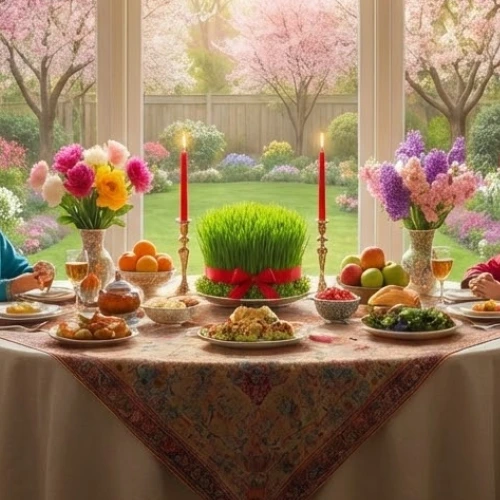
The centerpiece of Norouz traditions is the Haft-Seen (Haft meaning seven, Seen being the Persian letter 'S'). This is a stunning ceremonial table set with seven specific items, each beginning with the letter 'S' in Persian, symbolizing a hope for the year ahead.
Families gather around this table at the Saat-e Tahvil—the precise, astronomically calculated moment the new year begins.
Sabzeh (sprouted wheat or lentils): Symbolizes rebirth and renewal.
Samanu (sweet pudding): Represents affluence and fertility.
Seeb (apple): For beauty and health.
Senjed (dried oleaster fruit): Signifies love.
Seer (garlic): Denotes medicine and good health.
Somāq (sumac berries): Symbolizes the triumph of good over evil.
Serkeh (vinegar): Represents age and patience (the wisdom that comes with it).
The table is often complemented by a holy book, a mirror (for reflection), lit candles (for light), and a bowl with goldfish (representing life). It is a feast for the eyes, telling a story of hope and fortune for the coming year.
3. Nature's Grand Finale: Sizdah Bedar
The Norouz holiday lasts for 13 days. The final day, Sizdah Bedar ("Thirteen Outdoors"), is arguably the most beloved. Since the number thirteen is traditionally associated with bad luck, Iranians make sure to spend the entire day outdoors to avert any misfortune.
The day turns into a massive national picnic. Parks, fields, and mountainsides fill with families gathering for feasts, music, games, and dancing.
The culminating ritual of Sizdah Bedar involves the Sabzeh from the Haft-Seen table. It is believed that the sprouts have absorbed all the bad luck from the household over the past 12 days. To fully clear the house of negativity, the Sabzeh is taken on the picnic and tossed into a running stream or river. This act symbolizes letting go of the previous year’s pain and releasing the earth’s growth back to nature.
Conclusion: A Timeless Story of Hope
Norouz in Iran is far more than a public holiday; it is an annual, emotional, and spiritual commitment to rebirth. From the purifying fire jumps of Chaharshanbe Suri to the symbolic beauty of the Haft-Seen, and the joyous final outing of Sizdah Bedar, these Norouz traditions connect modern Iranians with their ancient heritage. They remind everyone that just as nature renews itself, so too can we.